
A safety walk-through helps you spot hazards for your tenants. Writing it down gives you a record of what you checked and what you repaired. Walk the property before a move-in, after a move-out, and once a year in between.

How to use this
Walk the property at three moments: before a tenant moves in, after one moves out, and once a year during a long tenancy. Allow enough time to check each item and document anything that needs attention.
This is a checklist, not a legal standard or a substitute for a qualified inspection. Smoke and carbon monoxide alarm placement, egress windows, handrails and habitability rules vary by jurisdiction and building. Confirm local requirements, follow manufacturers' instructions, and use qualified professionals for structural, electrical, gas and other specialist work.
Give the tenant the notice required by local law and the lease before entering. Do not assume a single notice period applies everywhere.
Outside
Start at the curb and work toward the door.
- Address numbers readable from the street in daylight and after dark. Emergency responders should be able to identify the unit.
- Walkways even, with no lifted slabs, loose pavers or trip edges.
- Steps solid, with consistent riser heights and no loose treads.
- Handrails secure and present wherever required by local code.
- Exterior lighting working at entries, along walkways and over stairs. If a bulb keeps failing, have the fixture checked.
- Grading sloping away from the foundation, with downspouts discharging clear of the walls.
- Decks and balconies visually checked for loose connections, damaged railings, corrosion and decayed wood. The connection to the house deserves particular attention. Do not load-test a suspect railing or deck; keep people away and arrange a qualified inspection.
- Deck age and inspection history written down. Unknown construction details, deterioration or movement are reasons to get professional advice.
Doors, locks and escape routes
Two things matter here: keeping the wrong people out, and getting the right people out.
- Exterior locks operating smoothly without lifting or shouldering the door. Check required locks and inside release against local code.
- Strike plates securely anchored into appropriate framing, not just trim. Use suitable hardware and installation instructions rather than assuming one screw length fits every door.
- Locks rekeyed or access codes changed between tenants, as applicable. Account for spare keys and previous access.
- Required bedroom escape windows open and stay open as designed. Painted-shut and swollen sashes are easy to miss during a showing.
- Below-grade bedrooms have code-compliant emergency escape and rescue openings where required. Have a qualified professional confirm dimensions and access.
- Security bars on required escape openings release from inside without a key or tool, as required by code.
- Window screens intact, but never treated as fall protection. Consider code-compliant window guards or stops where children could fall, without obstructing required emergency escape.
- Hallways, stairwells and exits clear of stored items.
Alarms and fire safety
A missing, dead or expired alarm can go unnoticed. Check the device, not just whether it is on the wall.
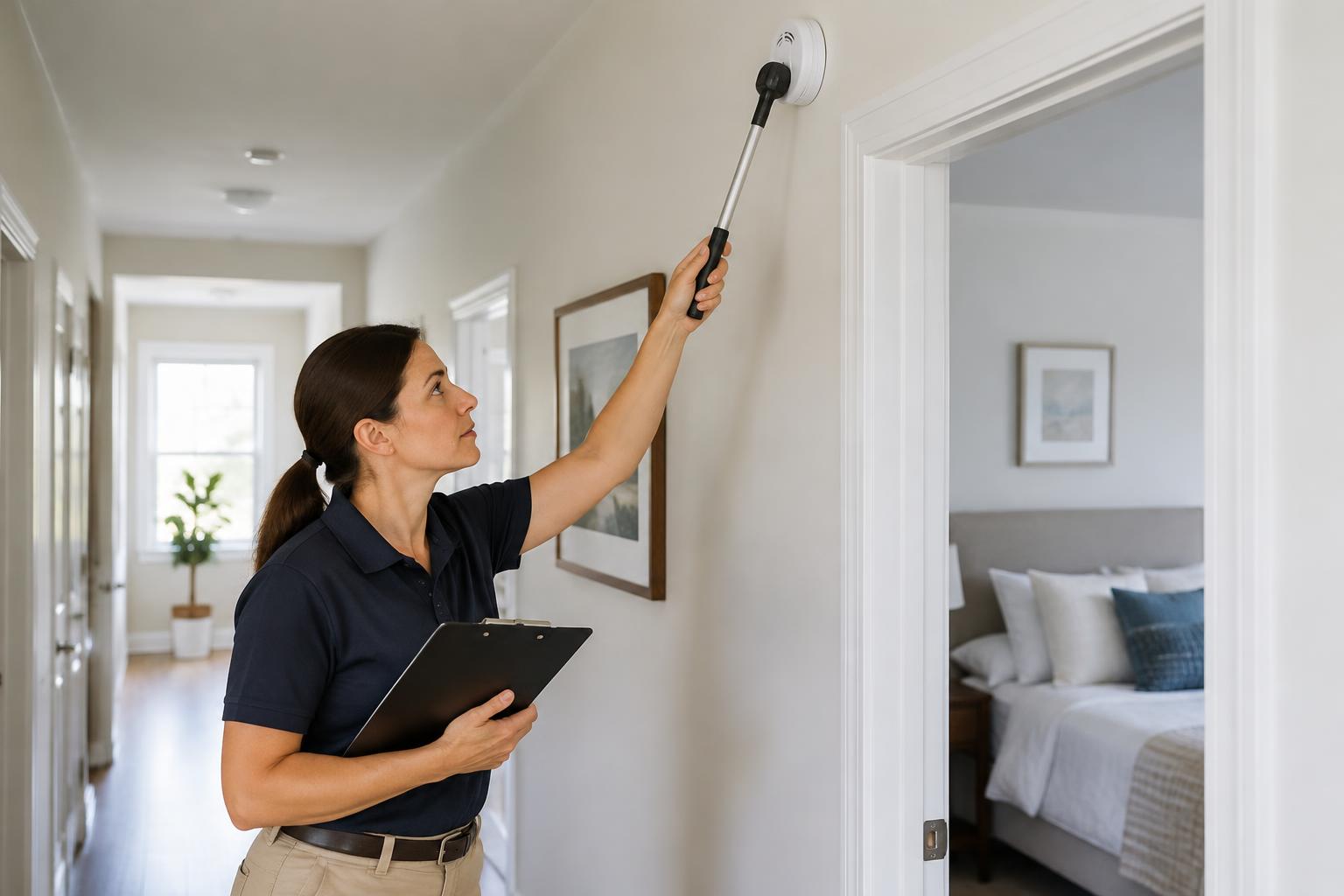
Smoke alarms
- In every bedroom, outside each sleeping area and on every level, including the basement, following local requirements.
- Tested using the manufacturer's procedure, with the test date written down. USFA recommends monthly testing; the annual walk-through does not replace those checks.
- Batteries maintained according to the label. Sealed-battery units are replaced when required, not opened for a battery change.
- Manufacture date checked. USFA recommends replacing smoke alarms ten years from that date.
- Required interconnection working, so the other alarms sound when one is tested.
Carbon monoxide alarms
- Check requirements for the property, especially with fuel-burning appliances, fireplaces or an attached garage.
- Installed on each level and outside sleeping areas according to manufacturer instructions and local rules; some properties require additional locations.
- Tested and within the manufacturer's replacement interval. CO alarms expire too.
Fire
- Appropriate extinguisher accessible near the kitchen exit, not where a stove fire would block access. Check its condition and service requirements; show the tenant where it is.
- Dryer vent clear of lint along its whole run, not just at the opening.
- Nothing stored against the furnace or water heater; maintain the clearances the equipment requires.
Heating, water and electrical
Heating
- Serviced as recommended, with the date and company on record.
- Visible vent connections intact, with no gaps, rust or disconnected sections. Leave combustion and venting assessments to a qualified technician.
- Filter changed, and the tenant told who is responsible and how often to check it.
- Required clear space around the unit.
Water heater
- Check hot-water temperature to reduce scald risk. CPSC recommends a 120°F setting for residential water heaters; have a qualified professional reconcile scald protection, system design and local requirements.
- Temperature and pressure relief valve and discharge piping present and unobstructed. A missing or capped discharge is a serious concern for a plumber; never cap or modify it yourself.
- Seismic strapping where required.
- No corrosion or moisture at the base. Record age and service history rather than assuming a tank has a fixed remaining life.
Electrical
- GFCI protection checked in required locations, including wet areas and outdoors. Use TEST and RESET according to the device instructions.
- Panel labeled, reachable and kept clear according to applicable requirements. Do not remove its cover.
- No extension cords doing the permanent work of outlets.
- Outlets and switches intact, covers fitted, no scorching, unusual heat or buzzing. Stop using a suspect device and arrange an electrician's assessment.
- Knob-and-tube or aluminum branch wiring referred to an electrician. Its condition is not a landlord judgment call.
Moisture, ventilation and appliances
Small leaks are easier to address before they become a larger moisture problem.
- Open the cabinet under every sink and look at the back corner, not just the front.
- Check ceilings and walls for staining, especially below bathrooms and around chimneys.
- Confirm bathroom fans move air and discharge outside, not into the attic.
- Confirm the dryer exhausts outside through manufacturer-approved ducting.
- Look for condensation between window panes, which can indicate a failed seal.
- Check accessible crawl spaces or basements for standing water and damaged vapor barriers. Do not enter an unsafe space.
- Run appliances according to their instructions and note unusual noise, leaks or faults.
- Confirm the range's anti-tip device is installed and engaged using the manufacturer's procedure. Do not pull or tip the range to test it yourself.
- Test the garage door's reversal and obstruction sensors according to the opener's manual. Keep people clear and stop using a door that fails the test until repaired.
Write down what you checked
A dated record makes it easier to show what you checked, track repairs and answer questions later. It does not guarantee legal protection, coverage or the outcome of a claim or deposit dispute.
For each pass, record:
- The date and who walked the property.
- Each item checked and the observed result.
- Dated photos, particularly of alarms, the water heater, the panel and anything you flagged. Respect the tenant's privacy.
- What was repaired, when and by whom.
- Invoices and receipts filed against the property rather than left in an inbox.
Be specific about alarm tests. “Smoke alarms tested, all bedrooms, October 11, 2026, photo attached” is more useful than remembering that you probably checked them in the spring.
Keep the record somewhere that survives a change of phone, a full inbox and a few years. In MaintFolio, you can organize the property and its equipment, attach documents and photos, and add the maintenance tasks you choose. Nothing on this checklist becomes a task unless you add it.
For a repeatable approach, see the quarterly property walk-through checklist, the dryer vent maintenance guide and the guide to turning an inspection report into a maintenance schedule.